


Deel nu!


Authors: Fabian Laubacher and Ralf Meisterjahn | July 2026 | Article
Key Facts at a Glance
- Small parts, critical impact: Micro molded elastomer components are essential for sealing and system reliability. Micrometer-level deviations can lead to leakage or failure.
- Precision requires full integration: Performance at micro scale depends on the interaction of design, material behavior, and manufacturing not on a single factor.
- Early engineering ensures consistent results: Combining early collaboration, simulation-driven design, and precision transfer molding reduces risk and enables reliable, scalable production.

As products across industries become increasingly compact and functionally integrated, micro molded parts play a decisive role in system reliability. In applications such as medical or household appliances, even the smallest elastomer component can determine whether a system performs consistently or fails prematurely.
However, designing and integrating micro sealings presents a unique set of challenges. At these small scales, factors such as tight tolerances, material behavior, and assembly constraints become significantly critical. Minor deviations in geometry or material properties, often in the range of just a few micrometers, can lead to leakage, reduced durability, or complete system failure.
Crucially, a single factor rarely causes these risks. Instead, they result from the interaction between design, material selection, and manufacturing processes. When sealing performance is considered too late in development, engineers face micro molding tolerance problems, costly redesigns, or persistent reliability issues.
To avoid these pitfalls, successful applications rely on early collaboration with sealing specialists, combined with deep material expertise, simulation-supported development, and specialized manufacturing technologies. By addressing sealing requirements from the outset, engineers can design micro molded parts that do more than meet dimensional specifications: they also deliver consistent, long-term performance under real operating conditions.
The Challenge: Designing for Precision at Micro Scale
Micro molded parts operate at the intersection of miniaturization and functional reliability. As dimensions shrink, the margin for error decreases significantly.
Engineers must address critical challenges:
- Tight tolerances: Even micrometer-level deviations can impact sealing performance.
- Material behavior: Elastomers exhibit nonlinear properties that become more pronounced at small geometries.
- Assembly constraints: Limited installation space increases the risk of deformation or misalignment.
- System integration: Components must function reliably within dynamic systems, such as pumps and valves.
- Regulatory requirements: Applications in drinking water, food, or medical environments demand certified materials.
These challenges highlight the importance of early engineering involvement – ensuring that design, material selection, and manufacturing constraints are aligned from the outset.

The Solution: Integrated Engineering and Advanced Micro Molding
Overcoming the challenges associated with micro molded parts demands an integrated engineering approach that begins early in the design phase and extends through industrial production.
A key success factor is early collaboration between design engineers and sealing specialists – as early design decisions directly influence sealing performance. By addressing sealing requirements at the concept stage, engineers can align component geometry with functional requirements, reduce risks related to the integration of micro components in systems, and avoid costly redesigns later in development. This ensures that sealing elements are treated as functional system components rather than standard parts.
Material selection is equally critical. Due to increased sensitivity at small scales, elastomer behavior must be carefully evaluated in terms of flow during molding, compression set, elastic recovery, and resistance to chemical and thermal influences. This helps prevent typical defects and supports stable performance in demanding environments.
To further reduce risk, simulation-supported development is used to predict material flow, stress distribution, and deformation during assembly. This allows potential failure modes to be identified early and mitigates issues before tooling is finalized.
These design and material considerations are complemented by advanced transfer molding of micro parts, which enables precise control of material flow into complex geometries while minimizing defects. Combined with high-precision tooling and automated processes, this approach directly addresses common micro part production consistency issues, ensuring repeatable quality at an industrial scale.
Together, this integrated approach ensures reliable performance in demanding applications such as micro seals for pump and valve applications.
Results and Proof of Performance
KPI |
Conventional Approach | Optimized Micro Molding | Benefit |
|---|---|---|---|
| Manufacturing process | Injection / compression | Transfer molding | Improved precision |
| Geometry capability | Limited at micro scale | Complex micro geometries | Greater design freedom |
| Production scalability | Moderate volumes | High-volume production | Reliable supply |
| Quality consistency | Batch-based control | Integrated process monitoring | Increased reliability |
This comparison illustrates how specialized micro molding approaches significantly improve both performance and manufacturability.
Use Case: Micro Sealing Reliability in Coffee Machine Fluid Modules
Challenge:
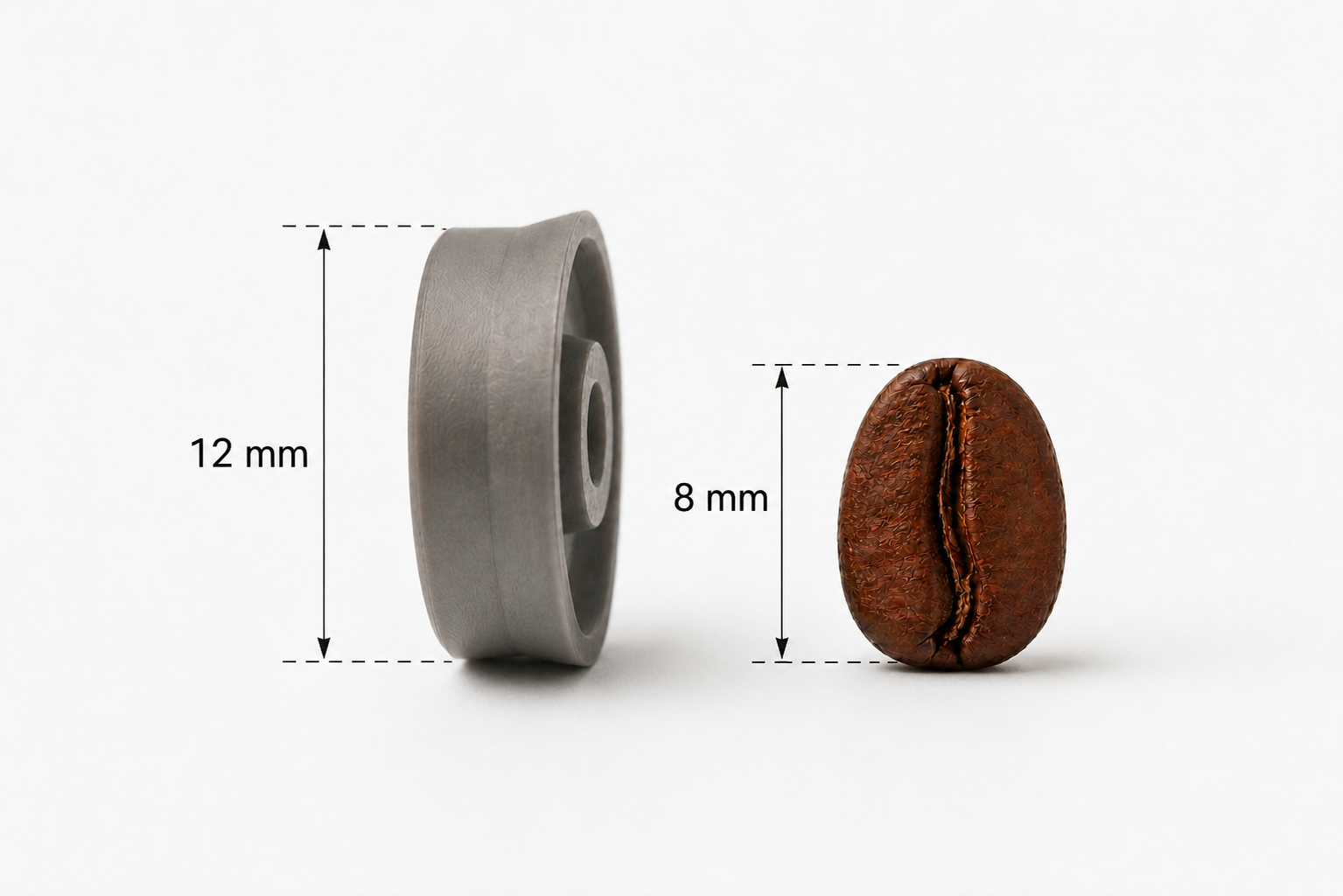
In compact coffee machines, micro sealing elements are used in valves, pumps, and fluid connectors where space is extremely limited. These components must withstand repeated pressure and temperature cycles while maintaining tight sealing. Common sealing issues in coffee machines often originate from micro-scale deviations in geometry and unstable material behavior, leading to leakage, pressure loss, or inconsistent fluid control.
Solution:
By applying tight-tolerance elastomer design and carefully controlling elastomer material behavior at a micro scale, micro seals are optimized for both functional performance and manufacturability. Simulation-supported development ensures correct geometry under operating conditions, while precision transfer molding enables consistent reproduction of micro features.
Result:
- Stable micro sealing performance under cyclic thermal and pressure loads
- Reduced leakage and improved fluid control accuracy
- Increased durability of micro sealing elements
- Consistent system performance over extended use
This demonstrates how addressing sealing failure causes in small components is critical for reliable micro sealing in compact fluid systems.
Conclusion
Micro molded parts are a cornerstone of modern product design, enabling compact, efficient, and high-performance systems across industries.
However, their successful implementation requires more than precision manufacturing. It depends on a deep understanding of material behavior, geometry, and system integration, combined with early engineering collaboration.
Angst+Pfister supports this process through integrated expertise, advanced molding technologies, and application-driven development – ensuring that even the smallest components deliver reliable, long-term performance.
As miniaturization continues to shape industries from medical technology to household appliances, the importance of well-engineered micro components will only increase.
Frequently Asked Questions
1. What are micro molded parts and why are they important?
Micro molded parts are small elastomer components used for sealing and fluid control. They are critical for ensuring reliability in compact systems such as pumps, valves, and medical devices.
2. What challenges arise when designing micro molded elastomer parts?
Key challenges include tight tolerances, complex material behavior, limited installation space, and ensuring reliable system integration.
3. Why is transfer molding used for micro molded components?
Transfer molding enables precise material flow and consistent cavity filling, making it ideal for producing small, complex geometries with high repeatability.
4. How can engineers improve the performance of micro molded parts?
Early collaboration with sealing experts, simulation-driven design, and optimized material selection are essential for improving performance and reliability.
5. In which applications are micro molded parts typically used?
They are commonly used in pumps, valves, household appliances, automotive systems, and medical devices.
6. How does Angst+Pfister support micro molded part development?
Through integrated engineering capabilities, including material expertise, simulation, tooling, and high-volume manufacturing, ensuring reliable and scalable solutions.
7. What are medical micro molding requirements?
Medical applications require high precision, biocompatible materials, and strict compliance with regulatory standards to ensure safety and reliability.
About the Authors
Fabian Laubacher is Head of Engineering Sealing Technology at Angst+Pfister. With more than 20 years of experience in sealing technology, he specializes in the development and optimization of advanced sealing solutions for demanding industrial applications, focusing on engineering excellence and customer-specific innovations.
Ralf Meisterjahn is Head of Sales at Lübke & Vogt GmbH & Co. KG. He has extensive experience in sales and business development within the industrial components sector, supporting customers with tailored solutions and technical expertise for a wide range of applications.
Wij zorgen dat het werkt
Neem gewoon contact met ons op en we nemen snel contact met u op!
Blijf op de hoogte!
Meld u vandaag nog aan voor onze nieuwsbrief en ontvang onze nieuwste updates over producten en de laatste trends in de branche!